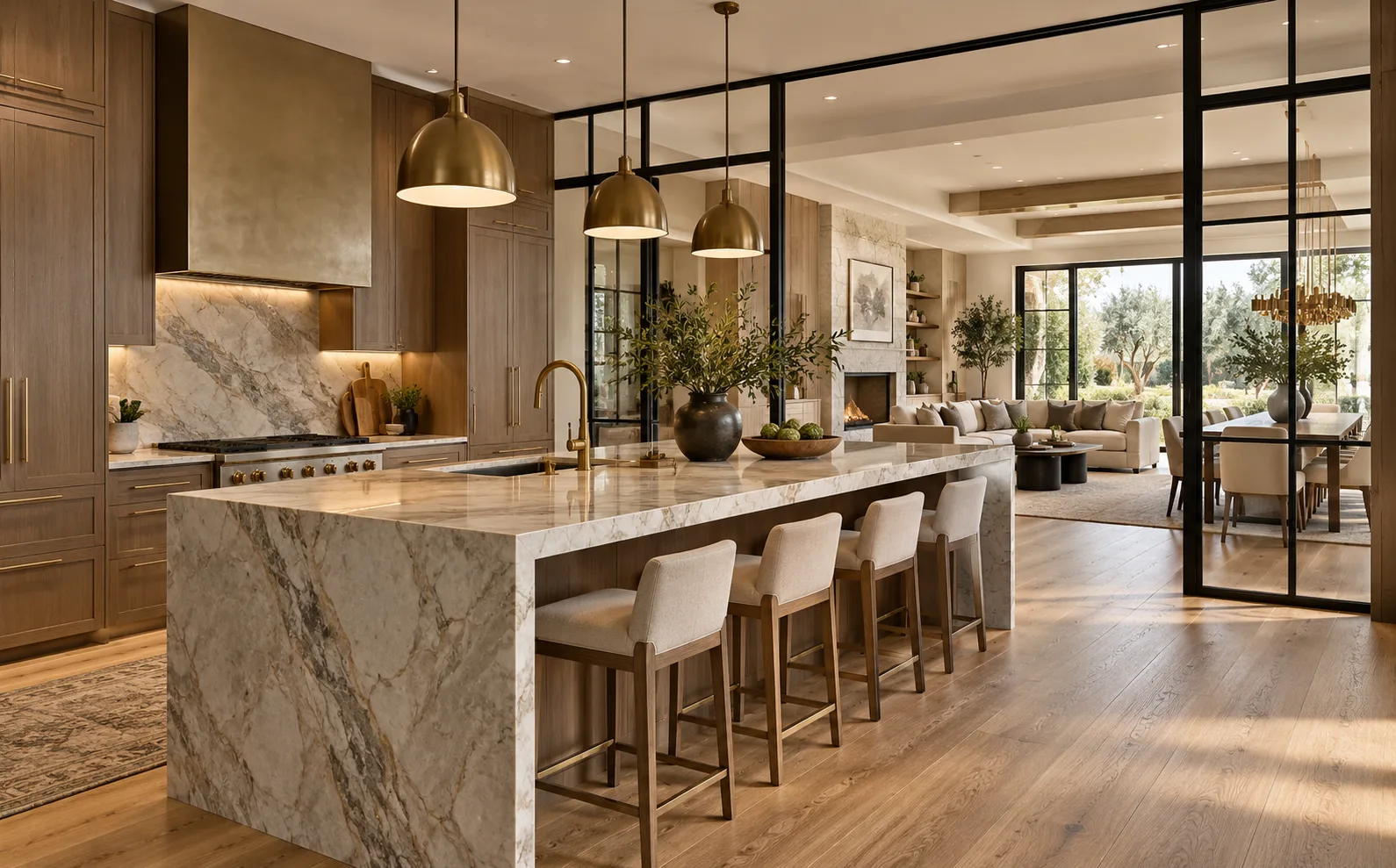
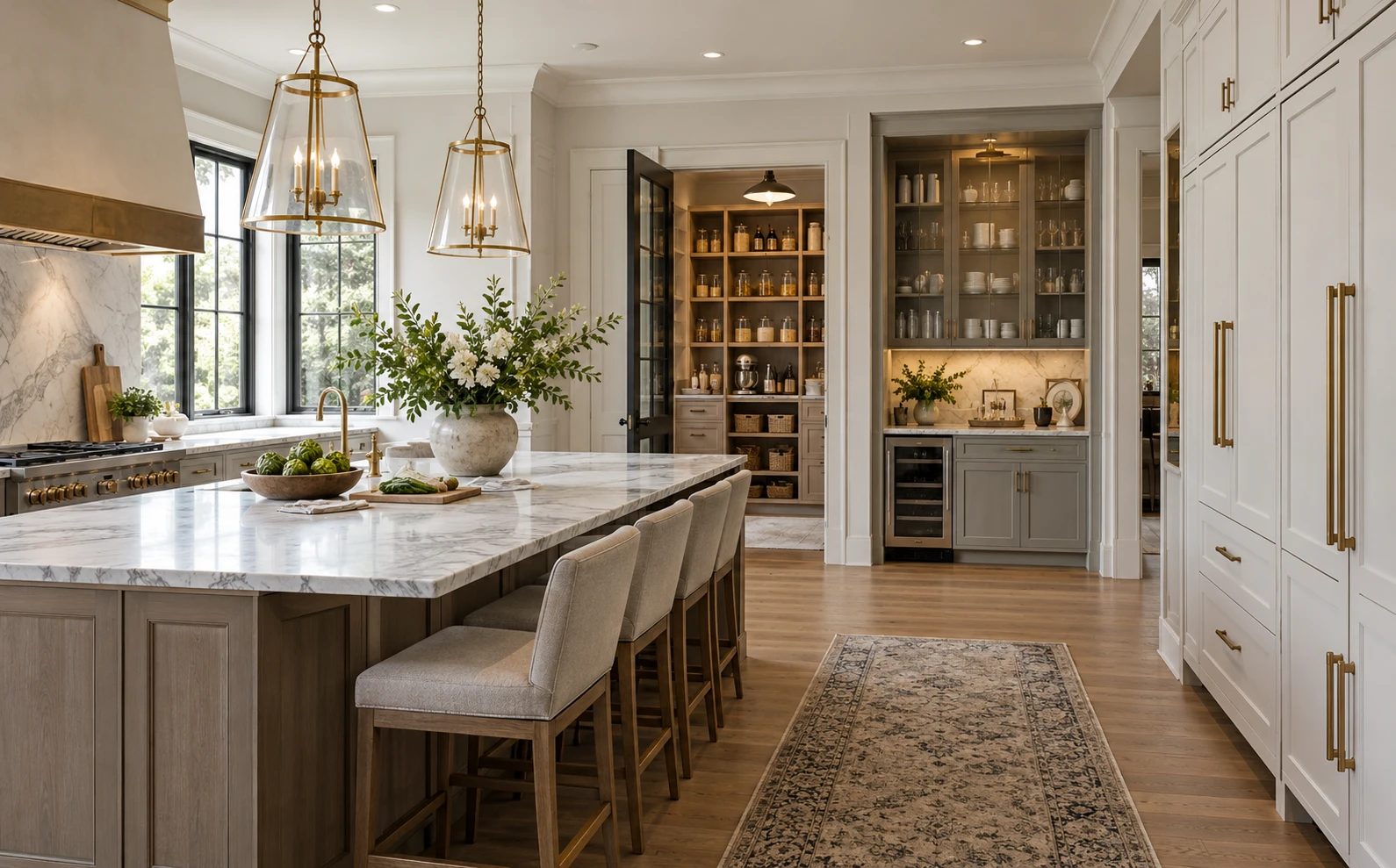
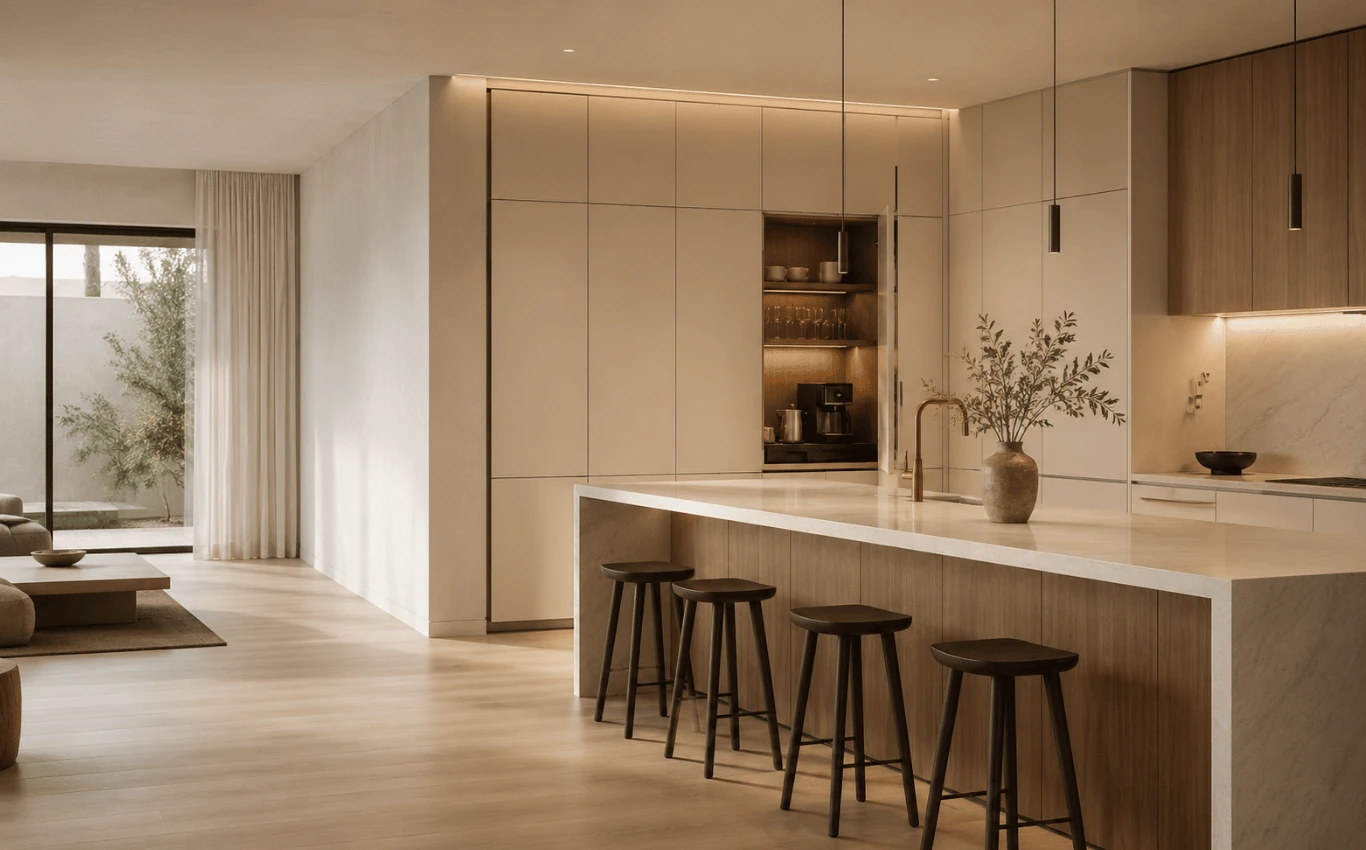
.webp)


Discover how kitchens in 2026 move beyond smart features to focus on calm, intuitive design that supports daily life without added complexity.



For years, the idea of a “smart kitchen” meant more screens, more apps, and more features competing for attention. Touch panels, voice commands, connected appliances, All promised convenience, yet often added complexity.
As we move into 2026, homeowners are beginning to recognize a simple truth: technology alone doesn’t make a kitchen better. In many cases, it makes it louder, more distracting, and harder to live with. The kitchens defining 2026 are no longer obsessed with being smart, they’re focused on being supportive.
These spaces move beyond visible tech and toward thoughtful design that anticipates behavior, reduces friction, and quietly improves daily life. Life after smart homes isn’t about removing intelligence from the kitchen; it’s about embedding it so deeply into the design that it disappears.


The biggest shift in kitchen design for 2026 is philosophical. Instead of asking what technology can we add, designers are asking what problems can we remove. The result is a kitchen that feels calmer, more intuitive, and far less demanding.
This human-first approach is central to Jeff Boico’s Kitchen Design services, where design decisions are guided by real routines rather than novelty.
Early smart kitchens required interaction screens to touch, commands to remember, alerts to manage. In 2026, the best kitchens operate silently in the background. Lighting adjusts without prompts. Appliances perform consistently without notifications. Nothing asks to be managed.
This evolution reflects lessons learned from earlier smart-home enthusiasm: convenience isn’t helpful if it creates new decisions.
Supportive kitchens are built around patterns, where hands naturally reach, how bodies move through space, and when attention is limited. Storage placement, appliance locations, and work zones are all designed to feel instinctive.
This concept builds on ideas explored in The Kitchen as a Control Room: How Design Reduces Daily Decision Fatigue, where design quietly absorbs mental effort instead of demanding it.
Rather than layering feature upon feature, kitchens in 2026 focus on refinement. Each element earns its place. If something doesn’t improve daily use, it doesn’t belong.
This restraint is what separates supportive kitchens from merely “smart” ones.

In 2026, intelligence in the kitchen is no longer something you see, it’s something you feel. The best kitchens don’t announce their capabilities; they simply work.
Lighting has become one of the most powerful tools in post-smart kitchens. Instead of dramatic scenes or manual controls, lighting now supports natural rhythms—bright enough when needed, subtle when not.
In the Port Washington, NY project, layered lighting strategies allow the kitchen to adapt effortlessly throughout the day without visual disruption. The intelligence is present—but never visible.
This approach aligns with insights from Elevating Your Kitchen with Lighting: A Guide to Ambient, Task, and Accent Options, where lighting is treated as behavioral support rather than decoration.
Invisible intelligence also shows up in the way cabinets open, drawers glide, and storage reveals itself exactly where expected. Nothing surprises the user. Nothing interrupts flow.
This level of predictability reduces hesitation and builds trust between the homeowner and the space.
In 2026 kitchens, appliances no longer command visual attention. They integrate seamlessly into cabinetry and layout, prioritizing cohesion over display.
When appliances stop being focal points, the kitchen becomes a calmer, more unified environment.

One of the clearest differences between smart kitchens of the past and supportive kitchens of 2026 is layout. The focus has shifted from efficiency alone to mental clarity.
Supportive kitchens use clear, intentional zoning. Prep, cooking, cleaning, and gathering each have defined territories, reducing overlap and confusion.
This principle echoes ideas from The 60-Second Kitchen Test: How to Tell If Your Layout Is Actually Working, where clarity reveals true performance.
When every item has a logical home and every action follows a predictable sequence, routines become automatic. This is especially important during high-pressure moments—busy mornings, late nights, or entertaining.
Supportive kitchens remove small pauses that add up to daily fatigue.
In 2026 kitchens, visual hierarchy matters more than ornamentation. Primary surfaces are clear. Secondary elements recede. The eye knows where to land without effort.
This calm visual structure allows the kitchen to feel organized even when actively in use.
Perhaps the most important distinction in 2026 kitchen design is longevity. Supportive kitchens are built to last, not just physically, but emotionally.

Technology dates quickly. Design philosophy doesn’t. Kitchens that rely on restraint, proportion, and thoughtful layout remain relevant long after trends fade.
The Roslyn Estates, NY project demonstrates how timeless design principles outperform feature-driven solutions over time.
Supportive kitchens minimize upkeep decisions. Durable materials, forgiving finishes, and practical detailing reduce the mental burden of maintenance.
This aligns with ideas from The Ultimate Guide to Kitchen Materials: Countertops & Flooring for a Luxury Home, where longevity is treated as a form of luxury.
Life after smart homes is flexible. Kitchens in 2026 are designed to accommodate evolving routines changing schedules, new family dynamics, and shifting priorities, without needing constant updates.
Supportive design allows the space to grow with you instead of locking you into a moment in time.
Life after smart homes doesn’t reject technology, it refines it. Kitchens in 2026 are no longer defined by how many features they advertise, but by how little they demand. They anticipate behavior, reduce mental load, and create an environment that feels calm, reliable, and intuitive. True intelligence in kitchen design isn’t visible on a screen; it’s felt in the ease of daily life. The kitchens shaping 2026 prove that when design leads and technology follows, the result is a space that genuinely supports the people who live in it.

Life after smart homes is calmer, quieter, and more intuitive. Here’s how kitchens in 2026 are designed differently.